








 9 min read
I’ve been going to a lot of community events lately, and I keep hearing the same thing from champions, almost word for word: “It’s hard to have fun anymore.”
The moderation queue never ends. Leadership wants ROI numbers yesterday. The same questions pile up day after day. You even start fearing for your job. And the creative, human side of community work (the part that got most of us into this role) keeps getting squeezed out by spreadsheets and support tickets.
But while you’re buried in all that, your community is quietly doing something incredibly valuable that most teams don’t even realize.
It’s building an organic search engine, saving your company real money, and creating a dataset that AI tools like Claude can turn into a genuine competitive advantage. And in 2026, all three of those things matter more than ever.
Your community is an SEO machine (and you probably don’t know it)
Every time a member asks a question, shares a workaround, or posts a product tip, they’re creating content that search engines love. As someone in growth marketing myself, this type of content is a gold mine. Not the polished, keyword-stuffed blog post kind. The real kind, written in the exact language your customers actually use.
That matters because 95% of all search queries are long-tail keywords with 10 or fewer monthly searches, according to Ahrefs. Your marketing team can’t write blog posts for all of them.
But your community members already are, naturally, just by having conversations. And long-tail queries tend to convert at significantly higher rates than broad terms because the intent is so specific. Someone searching “how to set up SSO with Salesforce in my community platform” is a lot closer to buying than someone searching “community software.”
Take Reddit as a proof point. After Google signed a $60 million annual deal with Reddit for AI training data in 2024, Reddit’s organic search visibility increased over 400%. Reddit ranks fairly high for queries like “best tire brands” and “what game should I play.” But the different LLM providers are switching gears to look at other sources, so think of this as your opportunity to shine.
Authentic community discussions signal real-world experience, which is exactly what Google’s E-E-A-T framework rewards. If you’re not really SEO-savvy, you’re probably thinking what the… is E-E-A-T. Well, here are the components to break it down.
- Experience: Does the content creator have first-hand, real-life experience with the subject? (e.g., product reviews, travelogues).
- Expertise: Does the creator have the necessary knowledge, skill, or credentials?.
- Authoritativeness: Is the site or author a recognized, go-to source in their industry?.
- Trustworthiness (Most important): Is the page accurate, safe, and honest?
Doesn’t our branded community hit all those criteria? Bingo! Except the traffic goes to your domain, not Reddit’s. That’s a crucial difference. When your customers ask questions in your community instead of on Reddit, the SEO value compounds on your site, not someone else’s.
Every discussion thread builds topical authority. Every Q&A post creates internal linking opportunities. HubSpot’s research on content clusters found that websites using cluster strategies (which community discussions naturally create) generate three and a half times more backlinks and see organic traffic increase by 55% over 12 months.
Building a successful online community takes intention, but the SEO payoff alone makes the investment worth it. If you’re a healthy online business, organic inbound can account for over 50% of revenue, think about your community impact with newfound focus.
Now add AI search to the picture
The search landscape has shifted in a big way. Google AI Overviews now appear in roughly half of all Google searches. ChatGPT processes over 2.5 billion prompts daily. And according to Similarweb, nearly 60% of Google searches now end without a click, meaning users get their answer without ever visiting a website.
This is the rise of AEO, or Answer Engine Optimization. It’s not just about ranking on page one anymore. It’s about getting your content cited inside AI-generated answers.
And community content is exactly what AI models keep pulling from.
Reddit represents 21% of all AI Overview citations, making it the top user-generated content source. Community platforms and forums punch well above their weight because AI models prefer authentic user experiences and real troubleshooting advice over polished marketing copy.
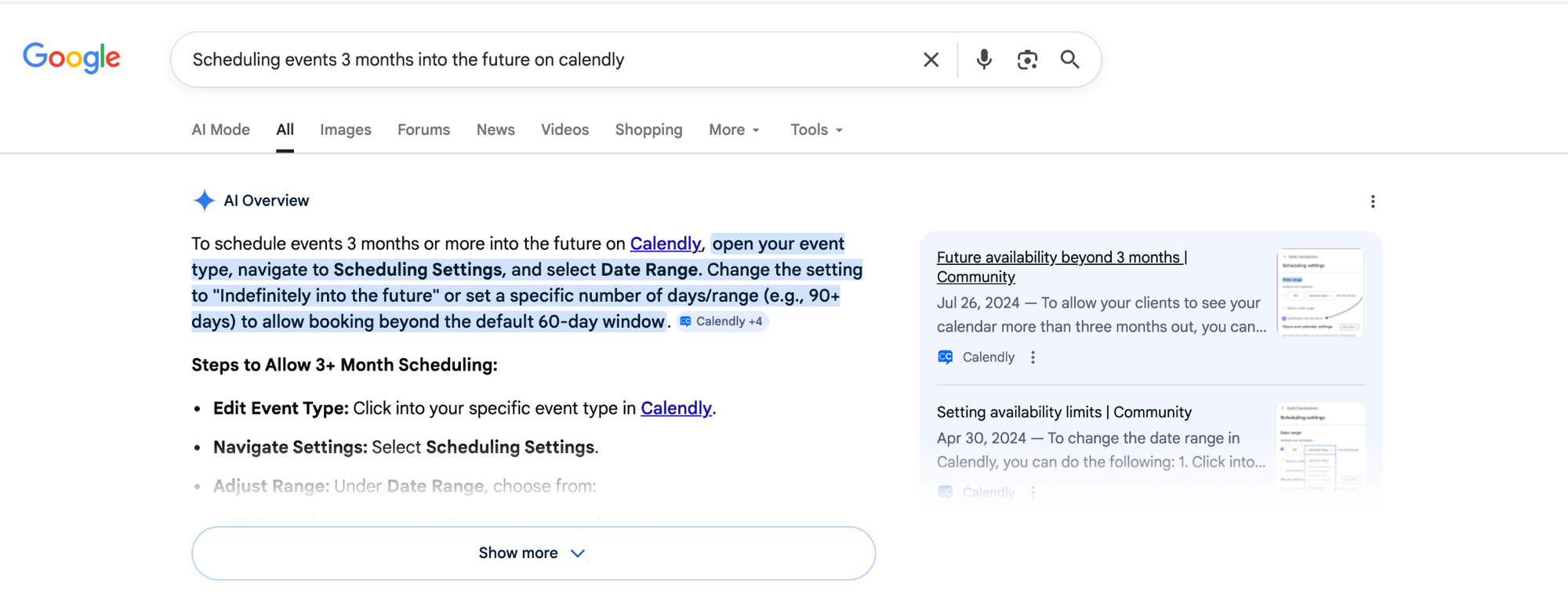
This isn’t theoretical. Jillian Bejtlich, who runs the community at Calendly, has seen it play out in real time. Search “scheduling events three months into the future on Calendly” on Google, and the AI Overview pulls its answer directly from Calendly’s community posts. Not from a help doc. Not from a blog. From real community members asking and answering each other’s questions. That’s Calendly’s owned community showing up as the trusted source in AI-generated results, driving users back to their platform instead of a third-party forum.
According to Acquia’s survey of 500+ marketing professionals, only 20% of organizations have started implementing AEO strategies. That’s a wide-open lane for community teams who are paying attention.
The ROI story goes way beyond search
SEO and AEO visibility are great, but they’re not the only numbers you can put in front of leadership. Community generates ROI in ways that are surprisingly easy to measure once you know where to look.
Support ticket deflection
This is the most immediate and easiest to quantify. When community members answer each other’s questions, those are tickets your support team didn’t have to touch.
HDI’s industry research puts the average cost per support ticket between $15-37 depending on complexity and channel, and B2B SaaS companies typically land in the $20-30 range. If your community deflects even 200 tickets a month, that’s $4,000-6,000 in monthly savings. Run that math against your ticket volume and the number gets leadership’s attention fast.
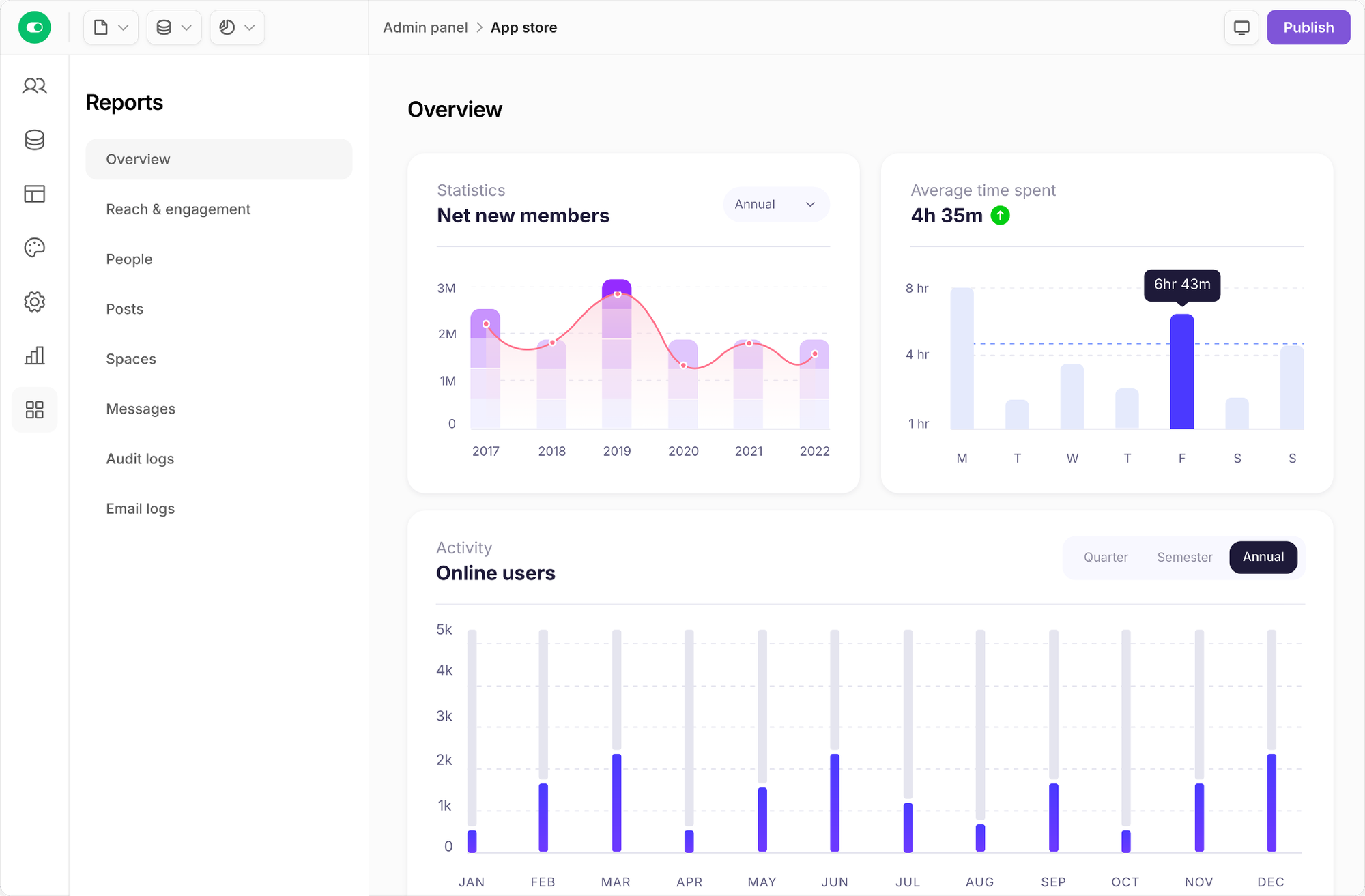
Looking to make the data real? If you use a platform like Bettermode, you can connect to Salesforce or HubSpot and create real-time dashboards showing dollar figures, where your executive team lives.
Customer retention
Customers who participate in community tend to stick around longer, and the data backs it up.
CMX’s 2024 Community Industry Report found that 86% of companies with community programs saw measurable improvement in customer retention and lifetime value. People who’ve built relationships, found answers, and invested time in your ecosystem don’t leave easily. That makes switching harder and renewing easier.
If your average contract value is $20K and community participation meaningfully lifts your retention rate, the revenue impact dwarfs the cost of running the program. From personal experience, I’m a big promoter of Clay & HubSpot; if it weren’t for their communities, I’m not so sure I would have stuck around as long as I have!
Product feedback loop
Your community is a live focus group running 24/7. Feature requests, bug reports, use case stories, and competitive comparisons show up organically.
Product teams that tap into this data ship better products and prioritize more accurately. How? Let an AI tool like Claude or ChatGPT analyze feedback in the community, and compare it to close lost reasons in your CRM.
The output? Real money lost, and your own priority roadmap for your team. This is the kind of strategic value that gets the community a seat at the table.
Content and growth engine for customer marketers
This one’s underappreciated. Every community discussion, Q&A thread, and member how-to guide is content your marketing team didn’t have to create. But it goes further than cost savings.
Nielsen research found that 92% of consumers trust user-generated content more than any other form of advertising. Your community is producing the most trusted type of content at scale, for free.
Repurpose the best threads into blog posts, case studies, social proof, or knowledge base articles. Turn customer success stories from your community into advocate marketing material. Use community Q&A as the basis for webinar topics or email campaigns. Some community teams produce more indexable, trustworthy content in a month than their content marketing team does in a quarter.
For customer marketers specifically, community is a growth channel hiding in plain sight.
 Jade Warne
AI tools are the multiplier (and they’re easier to use than you think)
So your community is generating SEO value, deflecting tickets, improving retention, and fueling your content engine. But you’re still stuck in the moderation queue and manually pulling reports. This is where AI tools like Claude come in, and not in the vague “AI will change everything” way. In the practical, “this saves me three hours on Tuesday” way.
If your community platform has an API (most modern ones do), you can connect it to Claude and automate a surprising amount of the repetitive work that’s eating your day.
And if your platform doesn’t have an API, you’re not out of luck. Claude’s Cowork mode can browse and read web pages directly, so you can set up scheduled tasks that visit your community dashboard, pull what it sees, and generate summaries or reports on a recurring basis. No API required.
Here’s what that looks like in practice:
Scheduled community digests
Set up a recurring task that pulls your community’s top posts, unanswered questions, and trending topics into a weekly summary.
With an API, Claude pulls the data directly. Without one, Claude Cowork can visit your community pages on a schedule, read the content, and compile a digest for you.
Either way, you get a summary dropped into your inbox or Slack instead of scrolling through every thread yourself.
Automated sentiment and escalation flagging
Feed your community posts through Claude and have it flag threads that are trending negative, contain churn signals, or need a staff response. You stop playing whack-a-mole and start intervening where it actually matters.
ROI report generation
Pull your community metrics (post volume, resolution rates, active members, top contributors) and hand them to Claude. You get a formatted monthly report with context and trends.
The report that used to take you half a day now takes five minutes and a prompt. Set it as a scheduled task and it shows up in your inbox on the first of every month, ready to forward to leadership.
Content repurposing at scale
Take your best-performing community threads and have Claude turn them into draft blog posts, knowledge base articles, social content, or advocate marketing material. The raw material already exists in your community. AI just packages it faster than any human can.
Member onboarding sequences
Use data on new member activity to trigger personalized welcome messages, suggest relevant threads, or nudge inactive new members. You’re not writing individual messages. You’re setting up a system that runs itself.
The point isn’t to automate the community into something sterile. The point is to automate the parts that are sterile already (moderation queues, report formatting, repetitive triage) so you can spend your energy on the parts that are actually human. Creative campaigns. Member relationships. Events people look forward to. The fun.
Stop surviving. Start having fun again.
Community work should be energizing. If it’s not, you’re probably spending too much time on the wrong things.
Let AI handle the grind. Let your members build your SEO moat. Let the data tell the ROI story. And spend your energy on the part of community that actually moves the needle: connecting real people and building something they want to come back to. That’s the conversation I want to have.
If you feel the same way, my colleague, Jacob Harris, Director of Customer Success at Bettermode, is hosting a live session on exactly this on May 7, 2026: How Community Can Be Fun & Show ROI.
Jacob will walk through these AI tactics live, share real examples from community teams who’ve figured this out, and get into the specifics of API + Claude workflows you can steal. Attend live and you could win a free year of Claude to put these ideas to work in your own community.
Because community should be the best part of your job. Let’s make it that way again.


Customer marketing insider
Thank you for subscribing
Level up your customer marketing skills and connect with experts worldwide.
An email has been successfully sent to confirm your subscription.
 Follow us on LinkedIn