








 9 min read
I was at a HubSpot INBOUND happy hour last year when a sales rep stopped me to say he'd loved PandaDoc at his last company and was already pushing to get his new one to buy it. Before I knew it, he'd pulled over their Director of Sales and the three of us were talking shop. A few weeks later, a call was locked in with our sales team.
As PandaDoc's Senior Customer Marketing Manager, I couldn't have scripted a better outcome. A genuinely organic prospect, and I was right there to attribute it to advocate influence. You'd best believe I took notes.
But if that same conversation had happened at an event I wasn't at, or in a private text or Slack thread, it would have been a black hole. No record, no attribution, no proof.
We know advocacy is happening whether we're tracking it or not. That's what makes it hard to show impact. And when you can't show impact, you end up stuck in reactive mode: fielding testimonial requests, producing case studies, without anyone really understanding what it all adds up to.
When I joined PandaDoc back in early 2024, customer advocacy was seen as a social proof generator. But with this way of thinking, the output is reactive, and the reporting becomes a list of things you produced. Of course, if that’s why you got hired, you have to give leadership what they want; I decided to adopt an MVP mindset: get customer stories in the door, get reviews coming in consistently. But my bigger mission was to start to prove what my programs are worth.
There are two things I had to do to evolve the thinking here:
- The first is building the reporting infrastructure to tell a story with your data.
- The second is evangelizing that story so the right people see the vision.
Step 1: Track what you can and tell a story with it
Customer marketing can easily be seen as a support and enablement function. Case studies produced, reviews collected, advocates signed up. All of that is important, but without the “why” behind it, nobody really cares.
I was talking to another customer marketer recently who mentioned their leadership wouldn't approve budget for reference management software. I asked them a few questions about their average deal size and how many reference calls they carry out monthly.
When you calculate ROI this way, it becomes a pretty straightforward ask. If you're running 15 reference calls a month, your average deal size is $35K, and reference-supported deals close even 15% more often, you can put a real number on what the software is worth and what business outcomes it generates.
This is the mental model I'd encourage anyone in customer marketing to apply across the board. Not just with reference calls, with everything possible.
Here’s how I did this at PandaDoc:
The influence of G2 reviews
G2 reviews are an underrated touchpoint that affects how fast deals close and how large they come in.
We had an account this quarter that started as an $820 ARR deal. Before signing a renewal, the customer recorded multiple sessions on G2 on our comparison pages against a competitor. They used that independent social proof to justify expanding and the deal closed at $8,937 – a 1000% increase in account value.
When we started treating G2 as a buyer touchpoint across the board, the numbers shifted fast.
We were able to see that our review expansion initiatives, taking us from 375 reviews in 2024 to 992 in 2025, correlated with a 513% increase in influenced pipeline ($5.6M to $34.4M). That’s worth the effort and cost we were putting into generating reviews on this channel.
Prospects who'd engaged with us on G2 were closing in 114 days on average vs. 176 for those who hadn't, and coming in 35% larger. Across 2025, we tied $8.66M in closed/won to deals that had a G2 touchpoint.
Using AI with G2
And then there's the AI angle that’s become a hot topic for everyone.
LLMs look to third-party websites like G2 to understand market sentiment, which means review volume, recency, and the specific language your customers use impact whether AI recommends you or your competitor.
In Q1 2026, PandaDoc had 105K+ citations across AI models, up 72% quarter over quarter. Every review we generated fed that. So now, we can tell the story of what it actually means when we get more customers talking about you publicly and the teams who prioritize third-party authority are already ahead.
 Stephen Akadiri
Advocacy program
Our advocacy program has its own numbers, too. In Q1, our advocates fuelled $330K in reference pipeline, with $319K of that closed. We can confidently say that out of the prospects who took a reference call with a happy customer, 96% of those converted.
We're also in the process of building out an advocate database in HubSpot, which aims to track how advocate engagement correlates with higher adoption, brand sentiment and customer lifetime value.
Tracking the untrackable
There are versions of the INBOUND conversation happening all the time that I'll never know about. The plug that happens at a happy hour or the recommendation dropped into a Slack thread. And while that may seem like a bummer, you can still invest in the conditions that make it more likely to happen.
Instead of shying away from the things that you can’t track, start creating moments where customers feel genuinely supported or get something valuable from the product. You can invest in this deliberately and watch the rest unfold from there.
On our end, we’ve started logging gifting activity in Salesforce as a signal we want to understand over time. Do customers who've had those surprise and delight moments show up differently in health scores, renewal rates and advocacy activity down the line? Maybe they don't. But it’s still worth testing!
So track what you can, but don't get so fixated on it that you miss how well moments land when you just put them in front of your customers. We sent a customer a gift basket and they took to LinkedIn unprompted and talked about what it meant to them. No pipeline number attached, and everyone immediately got it.
Step 2: Evangelise it across the organization
Having the data story is only half the job. If you’re not putting in the work to make it visible across the organization, it doesn’t matter how good your numbers are.
People come to me for different things - some for help with a reference call, others who need a specific testimonial, but often it’s hard for them to understand the big picture unless you take the time to share it with them. This is the part most customer marketers underinvest in, and trust me when I say I’ve been there!
We launched an advocacy platform with genuine momentum. We saw a 50% signup rate from invited customers, onboarded 110 customer advocates and enough reference capacity for over 500(!!) calls a quarter.
On paper, this looked like an incredible start, but in reality, our sales adoption was low. Too much still sat on my plate with manually matching references, keeping profiles updated and chasing account managers to remember the tool existed. I was the bottleneck and eventually we made the call to shut it down and rebuild with the actual users baked into the design from the start.
But the lesson wasn't about the platform. It was that I'd been spending all my time on what the program looked like externally and not nearly enough on how internal teams would actually engage with it, and both are make-or-break for your goals.
Your stakeholders aren't just helpful to have on your side – they matter most to the work you’re doing. Getting their buy-in requires the exact same approach you'd use with a customer: show the vision, give them proof points and make it easy to get involved.
Build a model people can understand
The thing that moved the needle internally more than anything else was painting a clear picture of how it all connected. I built out what we now call the Advocacy Flywheel, showing the three pillars that reinforce each other rather than operating in isolation.
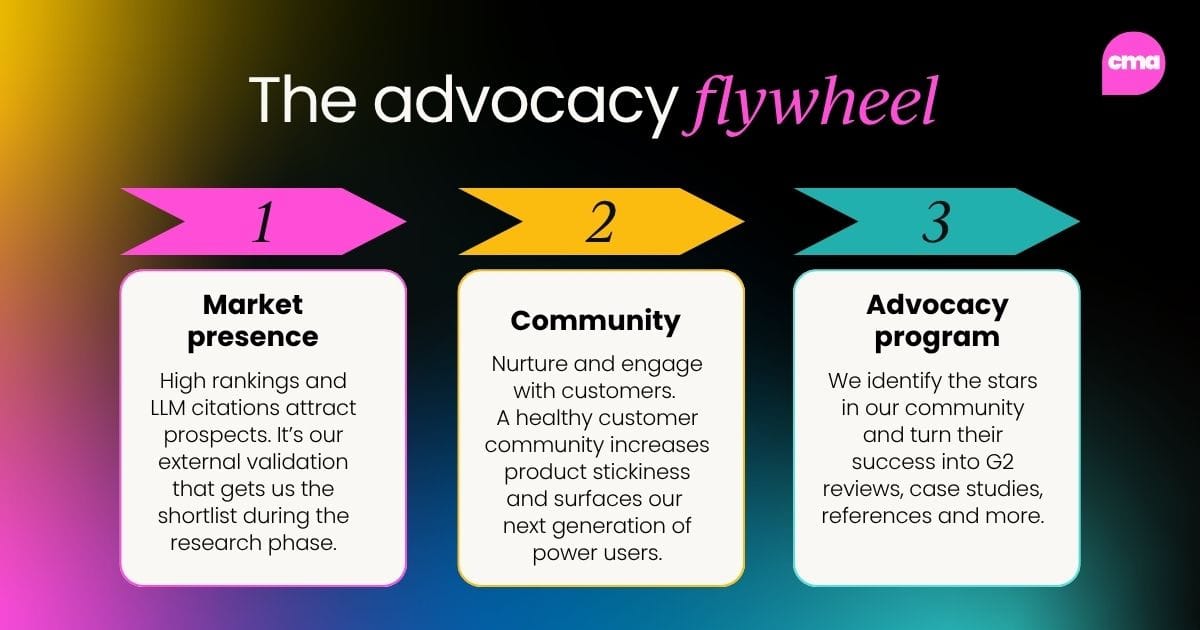
- Market presence: High rankings get you onto shortlists and appearing in LLM citations. In Q1 2026 we had 105K+ citations across models like ChatGPT and Gemini, up 72% quarter-over-quarter. When a buyer asks an AI tool to recommend a document platform, our review volume and keyword density influence whether PandaDoc shows up.
- Community: A healthy community surfaces your next generation of power users and allows us to involve customers in what they care most about.
- Advocacy: How we take customers who are raising their hand and sharing praises about us and give back to them. It’s about finding the stars and turning their success into reviews, product feedback, and thought leadership opportunities that support their growth.
Once the team could see that loop and how each piece fed the next, I started getting Slack messages and calls put on my calendar for all sorts of ways to collaborate.
Use social proof on your own stakeholders
We all know how powerful social proof is as part of the buying cycle, so it only makes sense that you'd use the same toolkit for your internal stakeholders.
I rolled out an advocacy QBR deck that I shared with teams across PandaDoc, focusing on what each department cares about most. I showed them the LinkedIn post from the customer who received the gift basket. I highlighted the renewal story where a customer went from $820 to nearly $9K because they spent an afternoon on our G2 page.
These are the kinds of stories that make the value of what I’m doing obvious.
 Teresa Garanhel
Sure, I had to spend a bunch of time putting this together and presenting it to different teams, but the result is that people understand the value advocacy programs bring and they want to lean in.
Once that’s established, the revenue conversation gets a lot easier, and you stop spinning your wheels on things that don’t move the needle because you (and your stakeholders) have seen what works.
The QBR really helped me gain the momentum I needed across teams. I stopped treating it as an update and reframed it as a story about how advocacy influences revenue.
Customer Marketing Alliance
Where we're headed
Attribution in customer marketing is still genuinely hard, and it’s all still work in progress for us.
We're heading into Q2 focused on centralising advocacy data in HubSpot so it lives where the revenue team already works + building attribution dashboards that can show how case study consumption influences pipeline. It’s a work in progress, and you don’t have to have it all nailed down to start sharing your successes. The story was already there before we decided to start tracking it.
Your customers are out there talking to your prospects right now, whether you've operationalised it or not. If you're early in this - start with one metric that leadership already tracks and trace your work back to it. The seat at the table isn't given to you. But once you show up with the right numbers and the right stories, the rest will follow suit.


Customer marketing insider
Thank you for subscribing
Level up your customer marketing skills and connect with experts worldwide.
An email has been successfully sent to confirm your subscription.
 Follow us on LinkedIn