







 9 min read
Most community-building content comes from people who’ve already won. They reached the 10,000-member mark, cut support tickets by 40%, and have an amazing story that community teams strive towards. That’s something that’s helped me in my journey to building a community at PandaDoc.
But I’ve found that it often skips the middle part – the part where you’re doubting yourself, trying to get buy-in and explain the value of community to your company.
I’m writing this from inside that middle, while the platform is still new, the launch plan is still under debate, and leadership keeps asking for numbers you don’t have yet.
The reason I moved our community off Slack
Before we even socialized the idea of investing in a community forum, we piloted a small, experimental Slack community with a few highly engaged customers. It passed 400 members in a single quarter, which felt like momentum, and in some ways it was. But the free Slack workspace we were using had gaps for what we ultimately wanted to build: a place for evergreen customer conversations and peer support.
We found that a great answer to a common question ended up dying in a channel nobody could find six months later. Often a new customer asked something that’d already been covered 10 times, and they either didn’t get a reply or had to wait for someone to retype an answer that already existed elsewhere.
There’s also next to no search visibility in-app, and no real lasting knowledge base. A prospect can’t stumble across a useful conversation our customers were already having. Don’t get me wrong, a Slack community works well for plenty of companies, but ours just wasn’t the right fit for what our customers needed, and that’s something this experiment helped us uncover.
A large share of our customers are self-serve. They don’t have an account manager and don’t talk to us on a 1:1 level regularly. Many are technical users who’ve built workarounds, custom workflows, and ways to push the product further than we documented. We knew these customers existed, but had nowhere formal to share their knowledge. In Slack, it surfaced briefly and then vanished, and because we had so little contact with these customers, we had a limited view into how they used the product.
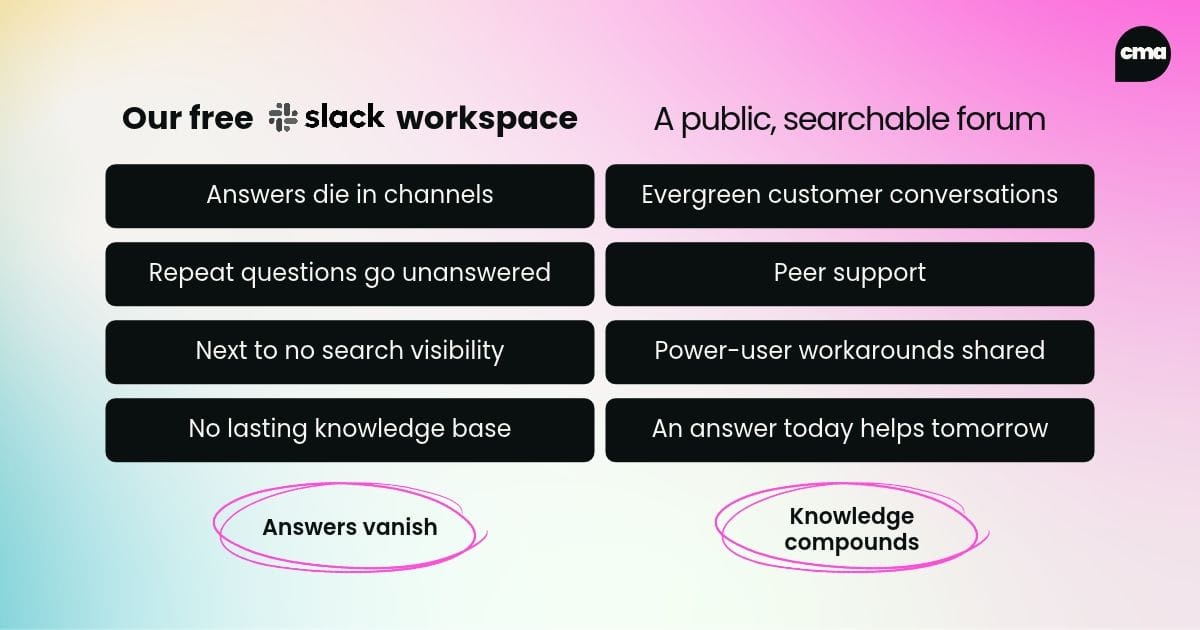
Our free Slack workspace was amazing for real-time conversation but struggled with anything that compounds. We knew we needed a public, searchable forum where an answer posted today can help someone tomorrow. A workaround a power user figured out in one city can help a new customer somewhere else six months later.
Build your community with customer problems in mind
Deciding what your community will look like typically starts when leadership identifies a problem they think a community can solve. While that's a good problem to have, it doesn’t put the customer at the heart of the conversation.
So at PandaDoc, we started with what could solve our customers' problems. For us, that was that customers had nowhere to talk to each other. Every question, best practice, and piece of hard-won product knowledge went through us: support tickets, CSMs, and me whenever someone needed a peer reference. The customers doing the most interesting things with the product had no place to share them.
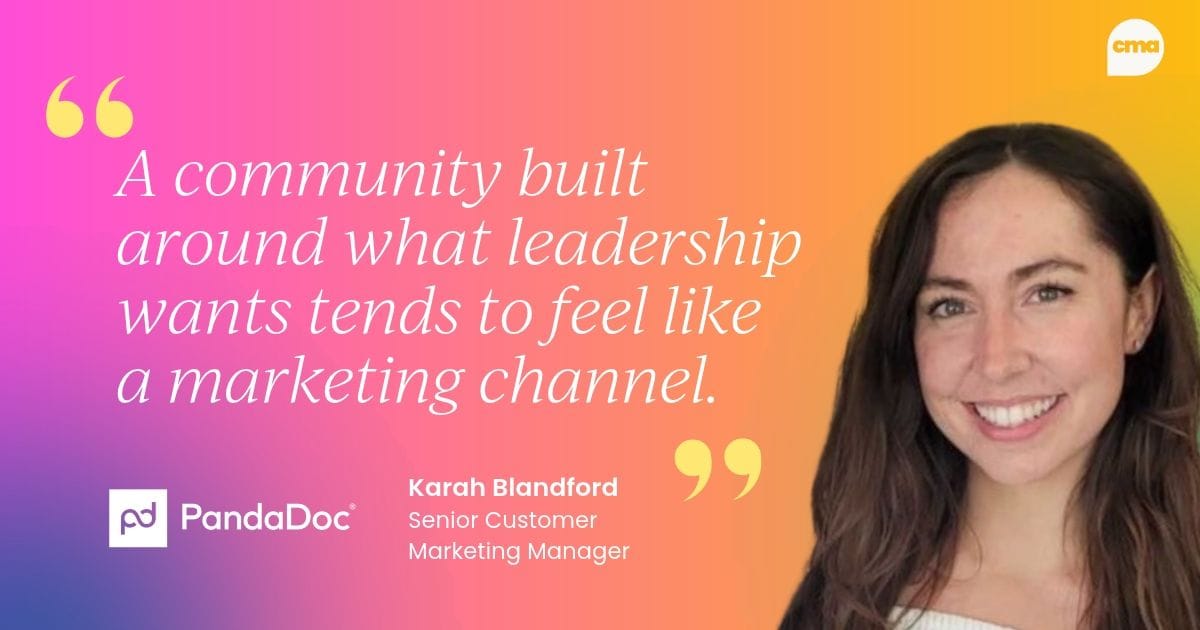
Our foundation became this: our customers deserve somewhere to find each other. We didn’t frame it as “we’re building a community to reduce support load,” even though that was partly true. The customer need always comes first, and it shapes what you build, how you moderate, what content you seed, and who you invite first. A community built around what leadership wants tends to feel like a marketing channel. One built around what customers need feels like a community.
Our founding cohort backed this up. We surveyed customers before we even started building, and 77% said they wanted tips and workflows from other users. 84% wanted product feedback that was actioned on and communicated to them. When it came time to launch, they joined because what we built offered them something they directly asked us for.
Starting with customers doesn’t mean ignoring the business. Once we knew what customers needed, we mapped where the same idea solved problems for other teams. That mapping is what helped us get the budget approved to build this, and the stakeholders to support it.
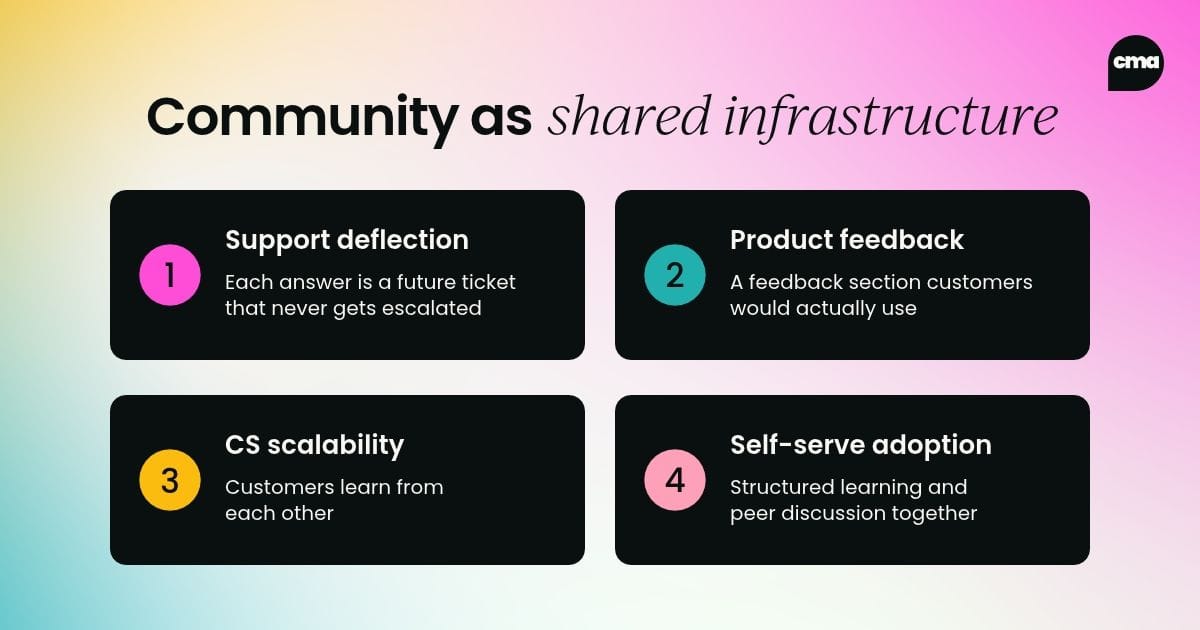
- Support was handling a steady stream of escalations with answers that already existed but weren’t findable. Each answer in a public forum is a future ticket that never gets escalated.
- Product had a feedback tool customers weren’t really using. A community with a dedicated feedback section, weighted by ARR and connected to our systems could give customers something they’d actually use.
- CSMs wanted their customers more involved but had large books and limited hours. Community lets customers learn from each other without a CSM facilitating every exchange.
- Marketing had a goal to deepen adoption among self-serve customers. We also had Learning Academy content customers loved, with nothing connecting it to conversation. Putting structured learning and peer discussion together made for a more holistic adoption strategy.
Laying that out team by team made the investment case easier. It stopped being “customer marketing wants a community” and became four separate cases: support deflection, product feedback, CS scalability, and self-serve adoption. Community became shared infrastructure, not a marketing project.
Choosing the platform
We were very deliberate in how we chose a platform for our forum. We ran a four-vendor RFP, covering purpose-built community platforms, forum software, and tools that live inside CRMs. Knowing what I know now, I’d run it the exact same way again.
The question that mattered most was integration: where the community sits in relation to your product and your revenue data. A community in its own silo, disconnected from your CRM, is hard to justify. You end up reporting engagement to a leadership team that thinks in ARR, and that translation wears you down over time.
We chose a platform that connects directly to Salesforce. Community activity (who’s active, what they ask, what feedback they give) lives where the revenue team already works. The community becomes part of customer health, not a side project someone has to remember to check.
I didn’t want the community to become a sales channel. But the program’s survival depended on leadership being able to see what it did for the business.
We’ve been here before with G2. Our review program was driving deals, and buyers were reading reviews, long before we could prove any of it. Once we built the attribution, we could connect millions in closed-won to G2 touchpoints. The activity had been there all along; we just hadn’t built the plumbing to see it.
Community works the same way. The compounding starts now, and the visibility comes later. Build for both from the start, or you’ll be retrofitting the plumbing in year two.
We built our community with a small group
Starting with a founding cohort is standard advice. But what we did differently was treat them as co-builders.
Before deciding anything, we asked open questions like:
- What do you want from this?
- What would make you show up?
- What would make you bring someone else?
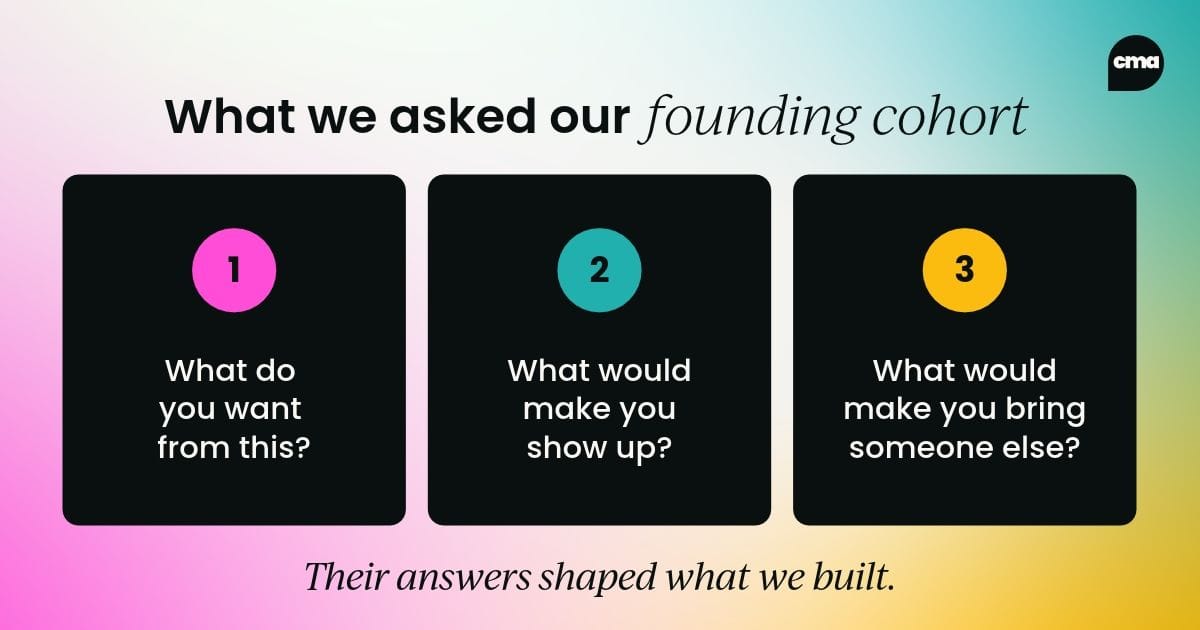
Their answers shaped what we built. They helped draft the community guidelines, reviewed the content strategy and told us where we’d missed, and tested the platform before we opened it up. Because they helped build it, they arrived at launch invested. They posted without prompting and moderated naturally, since the guidelines were partly theirs.
We split them into two groups. Champions were our highest-engagement advocates, people already taking reference calls and contributing to case studies. They were the ones I trusted to tell me the truth about what we were building. Our “Founding Members” were a broader group of customers who were part of our experimental Slack community.
Going small first makes sense for practical reasons. You need content before you have community, because an empty forum is worse than none. You need people willing to answer threads before the audience is big enough to answer its own questions. And you want the internal kinks worked out before mistakes have real consequences.
The bigger reason is culture. The first people set the tone for everyone who comes after. If they help build the place, they’ll protect it.
Seed your content in your community before your members join
Before the first member joined, we had 59 pieces of content ready.
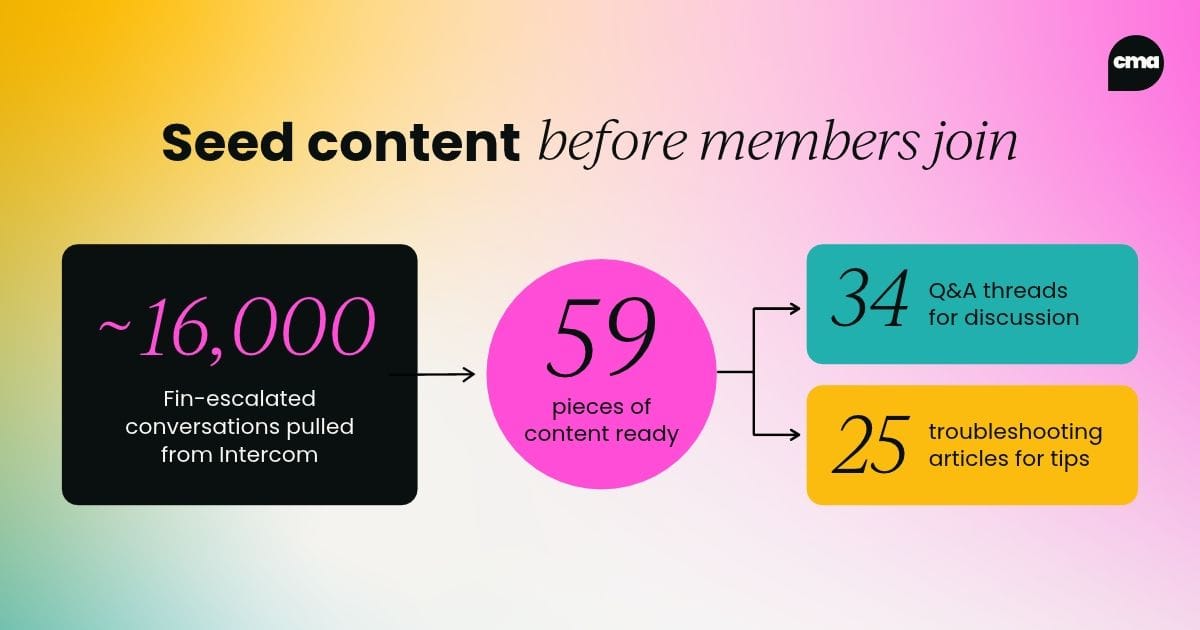
I didn’t write all of them, but over several months I worked closely with our Support Team to understand what customers struggled with. We pulled around 16,000 Fin-escalated conversations from Intercom and built the content strategy from what customers were actually asking. That gave us 34 Q&A threads for discussion and 25 troubleshooting articles for tips. This was the least visible work and probably the most important.
Members don’t want to be the first to speak in an empty room. If they arrive and find nothing, they leave. If they find a thread that addresses a problem they’re having, they reply, and that reply is where something real starts.
The ROI conversation
Around the 90-day mark, someone will ask how it’s going.
If you’ve built carefully, the honest answer is engagement rate and early signals. Not pipeline, not churn reduction, and nothing that maps cleanly to how most leadership teams talk.
I try to be upfront about the long game from the start, and I track leading indicators instead of waiting for lagging ones.
Engagement rate hit 50% in Q1 of the Slack community, against a 15% industry target. Weekly stickiness was 74.7%. That tells me the right people showed up and found it worth their time. Seven early access signups came from community members in Q1 2026, which tells me the community works as an adoption channel, not only a support channel. I also track the ratio of questions answered by customers vs. by the PandaDoc team. That ratio separates a real community from a moderated support queue.
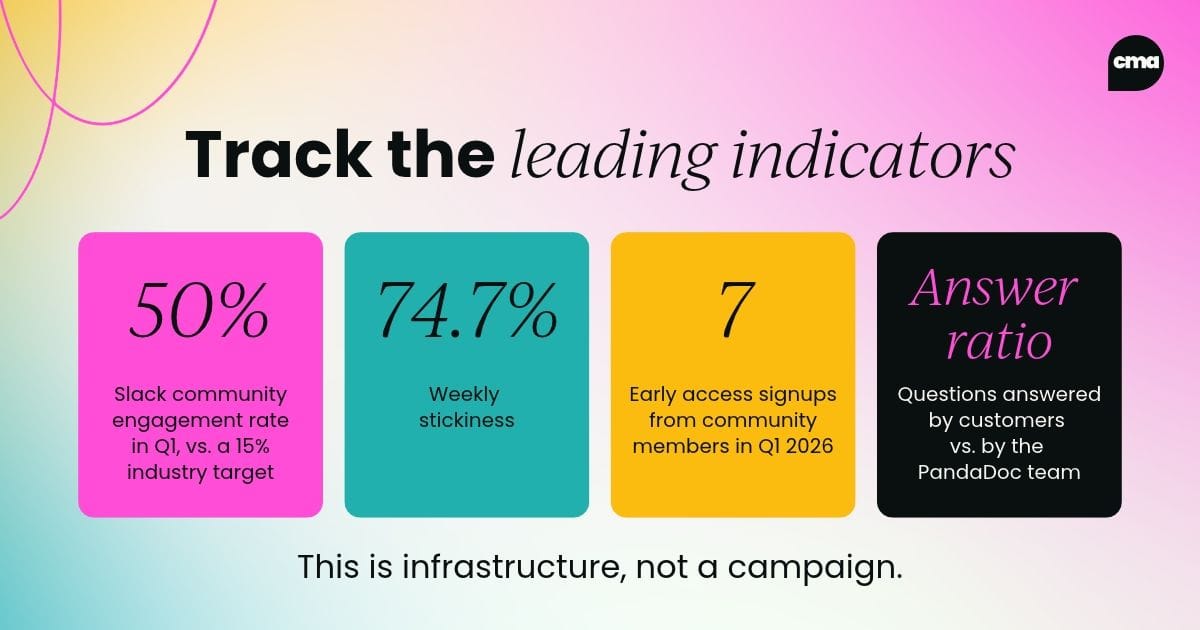
Leadership ultimately wants different numbers, but these indicators make the lagging ones more likely to follow.
The way I frame it internally: this is infrastructure, not a campaign. Infrastructure compounds. A forum post indexed today keeps working for you. The customer who gets a strong peer answer in month two might become your best advocate in year two. You can’t see that return yet, but you can check whether the conditions for it exist.
The clearest near-term business case is in user group events. We’re looking into building a program of city meetups and virtual sessions. The ROI there is more direct. Attendees adopt new features at higher rates than non-attendees, renew at higher rates, and make good candidates for advocacy. It will build relationship depth we can point to in a way engagement rate can’t yet.
How to get your internal teams on board
Building your external community is one problem, but getting internal buy-in, to get your colleagues to feed it and treat it as their own, is a different one.
Everyone I needed input from had full plates. Asking customer support to contribute content, asking CSMs to point customers to the forum instead of email, asking product to respond in the feedback section: each request looked like extra work for people already stretched thin.
What changed things was flipping the ask. Instead of asking what teams needed to put in, I showed them what came back.
- Support gets a knowledge base that builds itself and deflects tickets before they’re filed.
- Product gets the most engaged customers telling it what’s broken and what they want next, at scale and in their own words. We migrated 2k, somewhere product can engage with it directly and customers can see their feedback acknowledged.
- Customer success gets peer education at scale. A question that used to go to a CSM now gets answered by another customer a few steps ahead, which gives the CSM time back.
Once each team saw what it got out of the program, the conversation changed. That reframing is ongoing work, and it doesn’t stop at launch.
What I’d tell someone starting now
- Start with the customer problem. The business case follows, but it can’t lead.
- Launch smaller than feels comfortable. The instinct is to open the doors and let volume do the work, but volume without quality just creates noise.
- Build the content before the audience. The forum that exists when the first member arrives sets the tone for everything after.
- Say the long game out loud. Attribution catches up eventually, but you have to keep building while it does.
- Document as you go. The most useful writing on this topic isn’t the polished retrospective from someone who already won. It’s the honest account from someone in the middle, saying what they’re figuring out, what they got wrong, and what they’re watching.
That’s what this is. We launched on November 12th to our full customer base, and we’ll see how it goes. I’d love to hear from other Community Managers who’ve launched from the ground up. What did I miss? What has been valuable to you as you’ve built?


Customer marketing insider
Thank you for subscribing
Level up your customer marketing skills and connect with experts worldwide.
An email has been successfully sent to confirm your subscription.
 Follow us on LinkedIn