 5 min read
For the last decade, marketers have been chasing something of a holy grail: how to truly measure, influence, and complete the customer journey. We’ve all nodded politely at slides with “Edelman’s Loyalty Loop” — the idea that customers don’t march obediently down a funnel but instead circle in a loop of awareness, consideration, purchase, experience, and (if you’re lucky) loyalty.
It’s neat, it’s tidy, and in practice, it has been almost impossible to measure in real time.
Until now.
Because lurking in the wings is an unlikely hero: the GPT-powered shopping assistant. And with Google, Shopify, and OpenAI all releasing payment flows and product placements inside chat, the thing that once felt like science fiction is now inching toward your checkout basket.
The loop
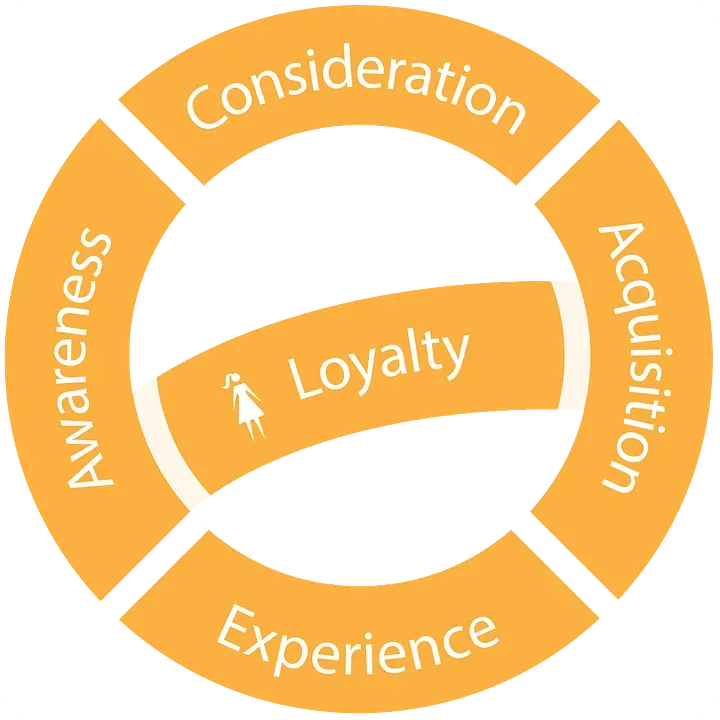
Awareness: The shelf talks back
In the old world, awareness meant billboards, shelf placement, maybe a Super Bowl ad if you were feeling particularly flush. In the new world, it might start with something as small as a prompt: “What running shoes are best for high arches?”
That single query replaces the billboard, the shelf, and the search result. Awareness is no longer a one-to-many broadcast but a one-to-one conversation. Control the conversation, and you own awareness. Miss it, and you’re invisible.
Consideration: The collapse of research
In Edelman’s loop, consumers bounce across reviews, friends, and YouTube demos. It’s messy and unpredictable.
GPT agents collapse that mess. They can pull in reviews, weigh sustainability scores, and summarize it in seconds: “You said comfort mattered more than price. These three fit the bill. Want to see alternatives?”
Consideration becomes less scavenger hunt, more curated dialogue — like having a data scientist and personal shopper tucked into a chat window.
Acquisition: One click becomes no click
For years, ecommerce worshipped the one-click checkout. With agent-enabled payments, “click” may vanish entirely.
If awareness, research, and recommendation all happen inside the chat, purchase does too. “Would you like me to order those now? Same size, delivery Tuesday.”
Conversion no longer lives on a page. It lives in dialogue.
Experience: The follow-up that actually happens
Here’s where things get fun. In Edelman’s loop, the post-purchase experience has always been a black box. Maybe you’d get a survey. More often, silence.
Agents don’t do silence. They follow up: “How did the shoes fit? Should I queue up a half-size larger?” Suddenly, experience isn’t a lagging indicator — it’s a live conversation.
For CMOs, this turns scattered reviews into structured signals. And structured signals, finally, are measurable.
Loyalty: Skipping the line
The whole point of Edelman’s loop is that loyalty shortcuts the process. If the experience delights, the customer doesn’t restart at awareness. They just buy again.
With agents, that shortcut is engineered. “Should I reorder your favorite coffee blend?” “Want to see what Ralph Lauren dropped this season, since you bought their jacket last fall? You do need some lighter weight trousers to go with that jacket.”
Loyalty is no longer an aspiration. It’s a behavioral loop — remembered, nudged, and reinforced by the agent itself.
And if you really nail it, loyalty doesn’t just loop — it advocates. Agents can make posting reviews or sharing recommendations effortless, turning the loop into a flywheel.
The coming commercial disruption
Every neat new consumer model leaves a trail of broken business models. For two decades, ad tech, social platforms, and retail media thrived on intercepting customers in the messy middle: search results, paid listings, influencers, targeted ads. That friction was gold.
But if GPT agents collapse awareness, consideration, and purchase into one thread, the gold starts to dry up. Why pay for impressions if the agent never shows them? Why fight for shelf placement if the shelf is now a chat window?
And what about content itself? Most of the internet isn’t made out of pure altruism — unlike this article (you’re welcome), it’s produced to monetize: ads, subscriptions, calls to action. Blog posts, reviews, recipes, tutorials all survive because someone can make money from the clicks. But if agents summarize that content and answer directly, without passing users through, the incentive to create dries up.
Fewer incentives mean less content. And less content doesn’t just starve the web — it starves the very foundation models that trained on it. Which raises the next question:
What will the models learn from?
If the open web shrinks, models will need new fuel. That fuel may be transactional data, agent-to-agent dialogues, and post-purchase interactions. Instead of learning from how people write, they’ll learn from how people buy and what they tell us about the experience.
But who decides how that learning works? Do agents learn just for me, as a personal AI? Do they pool data in the aggregate? Or do they attempt something in-between, anonymizing but still pattern-rich?
Each choice carries privacy implications. Learn too personally, and it feels like surveillance. Learn only anonymously, and nuance is lost. Consumers will likely demand more transparency into what their agent knows, and for whom.
Who now owns the loyalty loop?
This may be the most strategic question of all: will brands run their own agents, or will loops all sit under the big platforms?
Picture three futures:
- Brand-owned loops
Brands like Ralph Lauren license GPT tech to power their own branded agents, tuned to their voice, products, and experience. Customers trust “Ralph’s agent” as much as the brand itself. - Platform-owned loops
Loops collapse into centralized super-agents from Google, OpenAI, or Amazon. Brands rent space inside them, like tenants in a digital mall. - Personal agent mediation
A consumer’s own agent negotiates with brand agents. My personal AI knows my quirks and constraints; Ralph’s agent knows inventory and promotions. They interact, filter, and negotiate before presenting me with choices.
This third path reshuffles the economics. Consumers gain control, brands gain direct dialogue, and platforms fade into infrastructure.
Privacy also looks different: instead of raw transactions feeding platforms, much of the learning could happen in encrypted agent-to-agent exchanges. That balance may prove more sustainable than either total centralization or total fragmentation.
The CMO’s new instrument panel
For CMOs, this is the moment you’ve secretly been waiting for. For the first time, you could see — and influence — the entire loyalty loop in one connected flow assuming the commercials make sense for everyone.
No more pretending awareness can’t be measured. No more shrugging at the black hole of post-purchase. No more praying loyalty shows up on an NPS chart. With GPT agents, the whole journey becomes instrumented.
Of course, you’ll also need to relearn how to play the game. It’s not about pixels, it’s about prompts. Not about shelf space, but agent trust. Not about buying eyeballs, but being the answer when the consumer asks.
Closing thoughts
Edelman’s loop was always a neat diagram on a PowerPoint slide. Useful, but frustratingly intangible. I’ve been a believer in engaging with customers to better understand why they do what they do as posted below, which is a summary of a piece I wrote in August 2023.
With agentic AI, we may have more natural way to engage with consumers and the loop might finally come alive. If you have made it this far, drop a comment if you are interested in hearing my ramblings more on this topic.
The question isn’t whether consumers will adopt it — they already are, and the big platforms are racing to make sure of it. The question is: when the loop closes, will your brand be inside it… or out in the cold?


Customer marketing alliance insider
Thank you for subscribing
Level up your customer marketing alliance career & network with customer marketing alliance experts.
An email has been successfully sent to confirm your subscription.
 Follow us on LinkedIn